

Description
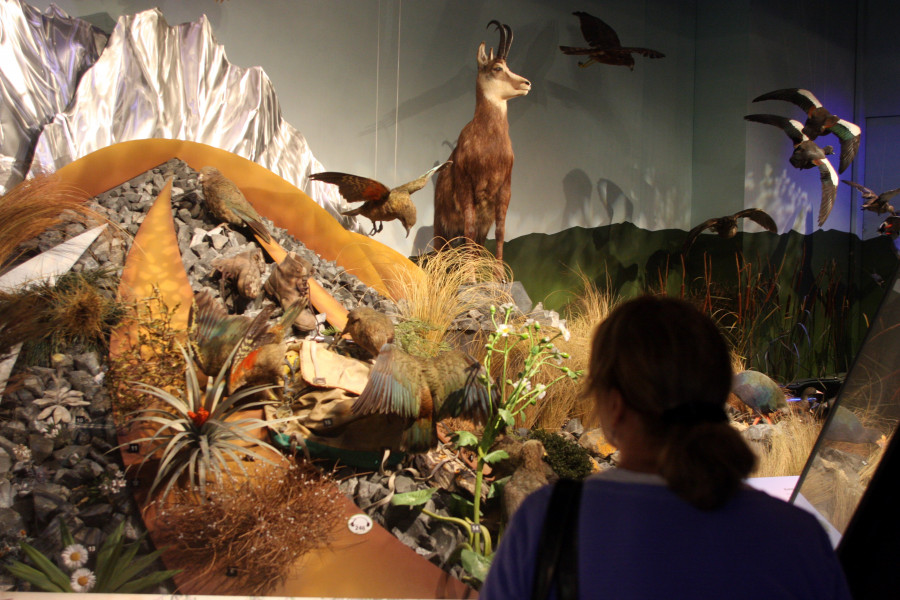
The Te Papa Tongarewa Museum is New Zealand's national museum, located on the waterfront in the capital city of Wellington. The Māori name translates loosely as "place of treasures of the land." Across six levels, New Zealand's rich culture is explored from a variety of perspectives. Visitors learn a wealth of fascinating facts about the country's history, from early settlement to the present day. The exhibitions are divided into the themes of art, history, Pacific, Māori and nature. In addition to the main building, the museum has a large wooded outdoor area where an artificial cave can also be visited.
Pacific
This exhibition boasts a truly remarkable feature: the heaviest squid ever caught intact is on display here. Never before had a complete colossal squid been recovered, making it of great importance to science and allowing researchers to learn more about this life form. The squid weighs 495 kilograms and lies in a six-metre-long water tank. The exhibition provides comprehensive information about these giant ocean dwellers. How does the squid live? How is its body structured? What other animals share its habitat? How is it caught?
Art
Ngā Toi | Arts Te Papa is the museum's art exhibition, currently devoted entirely to photography. A wide range of images from the museum's collection is on display. From 19th-century family portraits and captivating landscape photographs to spontaneous snapshots, everything has its place. Works by notable photographers such as Alfred Burton, Marti Friedlander and Anne Noble are also featured. Visitors can even get involved themselves: anyone who has taken a special photo of their own can share it on Instagram using the hashtag #tepapaphoto.
Māori / History
Mana Whenua is the exhibition that takes visitors on a journey to the origins of Māori culture. It sheds light on the special relationship between the Māori and the land, and presents the richness, complexity and dynamism of the culture. The exhibits range from carving and weaving to traditional canoes and buildings. The highlight is the elaborately decorated meeting house, Te Hau ki Tūranga.
Nature
Under the name "Awesome Forces", the museum presents New Zealand from a geological perspective. Visitors learn how plate tectonics, volcanic eruptions, earthquakes and erosion have shaped the islands of New Zealand. A video shows how New Zealand split from the supercontinent 85 million years ago. Enormous projections and animations explain the country's seismic and volcanic activity in vivid detail. In the "Shake House", you can even experience an earthquake for yourself.
Historical Information
The museum's predecessor was a small colonial museum that opened as early as 1865. In 1907, it became known as the Dominion Museum. The idea of an art gallery in Wellington emerged early on, but it could not be realised until 1930 with the National Gallery and Museum Act. In 1936, the museum moved into a new building on Buckle Street in Wellington, which also housed the Academy of Fine Arts. In 1972, the Dominion Museum was renamed the National Museum. By the 1980s, it was clear that the building was no longer adequate, with the art gallery suffering in particular. In 1988, the first idea for a new museum was born. During the 1990s, this idea took increasingly concrete shape, and the new museum was finally built. After roughly four years of construction, Te Papa opened its doors on 14 February 1998 at its current location on Cable Street in Wellington. Since then, millions of visitors have explored its diverse exhibitions. In 2013 alone, the museum recorded 22 million visits.
Interesting facts
- The day pass at Museum of New Zealand: Te Papa Tongarewa Wellington is NZD35 making it one of the 3 cheapest tourist Attractions in New Zealand.
How to get there
Das Museum befindet sich im Herzen Wellingtons direkt an der Waterfront.
Mit dem Auto
Über den Wellington Motorway kommend nimmst du die Abfahrt Aotea Quay. Danach Richtung Waterloo, Customhouse und Jervois Quays fahren. So gelangst du automatisch zur Cable Street.
Öffentliche Verkehrsmittel
Fast alle Busse des öffentlichen Nahverkehres halten am Courtenay Place. Von dort sind es nur zwei Minuten zum Museum.