
Description
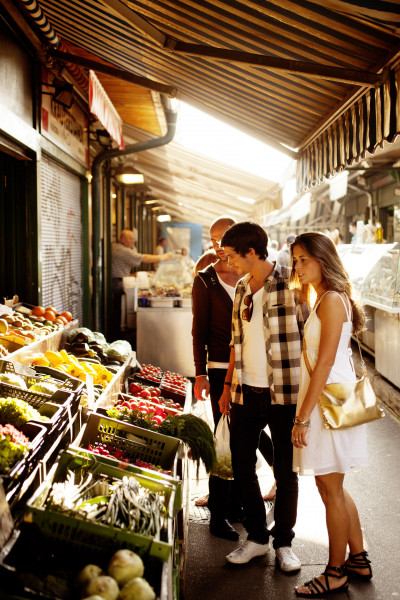
The Naschmarkt, often referred to as the "belly of Vienna", covers 2.3 hectares and is home to over 120 market stalls and eateries as well as 30 farmers' stands selling seasonal produce, fruit and vegetables.
Food and drink
The culinary range spans everything from traditional Viennese fare and seafood to Indian, Asian, Italian and Middle Eastern specialities. The organic offering at the Naschmarkt is also growing steadily. On Saturdays, several stalls sell organic produce and are marked with small "Bio-Eck" table flags so they are easy to spot. Since April 2018, a special themed market has been held once a month.
Around the Naschmarkt
To attract a younger crowd, DJs play at some of the stalls on weekends, and modern architectural touches have turned many of the old market stands into popular meeting spots. The streets around the Naschmarkt have also seen a wave of new restaurants and cafés capitalising on the market's appeal as a tourist destination. Every Saturday, a flea market takes place on a 7,000 m² site right next to the Naschmarkt, with around 400 private and commercial vendors selling their wares.
Historical Information

In the Middle Ages, the area where the first Naschmarkt emerged lay along the River Wien, surrounded by vineyards, and was home to two of the city's busiest brothels. Until 1774, an agricultural market occupied the site, but after public protest it was relocated outside the city gates, where it re-established itself as the Naschmarkt from around 1820.
Origin of the name
The exact origin of the name "Naschmarkt" remains unclear. It may derive from "Aschenmarkt" (ash market), as the site was previously used as an ash and rubbish dump. Another theory links it to a small milk market that once stood here — "Asch" being a traditional word for a milk pail — or, most likely, to the simple fact that sweets and treats ("Naschereien") were sold at the market. In 1905, the market was given its official name and at that time had as many as 900 stalls.
The Naschmarkt today
The market in its current form was designed by Otto Wagner and opened in 1916. During the First World War, permanent stall structures were built to a design by Friedrich Jäckel. These still define the look of the Naschmarkt today and are listed as protected monuments. In 1977, the flea market was moved to its present location. Major renovations took place between 1993 and 1998 and again from 2010 to 2015. In 2005, a ban was introduced on converting shops into restaurants, only to be lifted again in 2006. The aim had been to prevent the traditional market — with its fruit, vegetable and farm produce vendors — from turning entirely into a strip of modern bars and eateries.
How to get there
Naschmarkt is located between Karlsplatz and Kettenbrückengasse, and can easily be accessed on public transport. Subway lines U1, U2, and U4 stop at Karlsplatz, U4 also goes to Kettenbrückengasse.