
Description
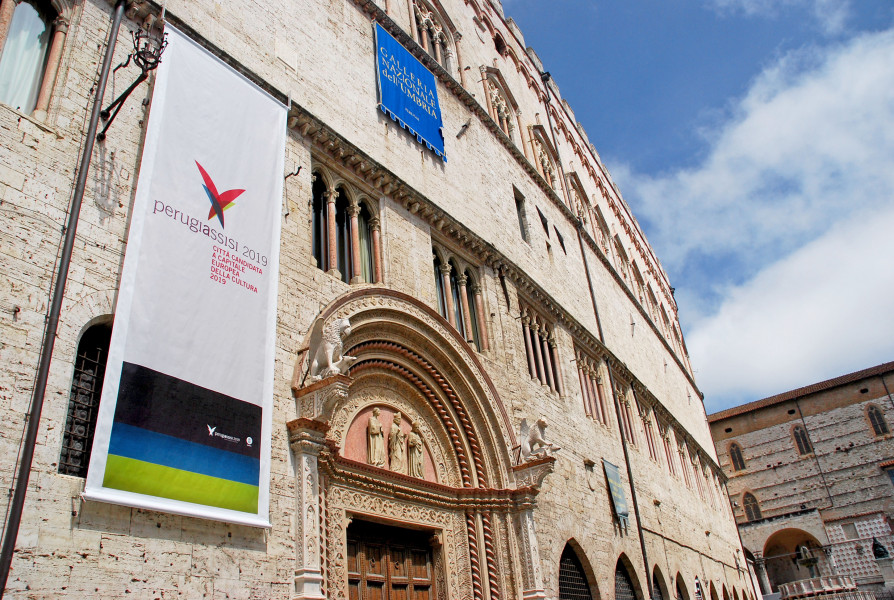
The Galleria Nazionale dell'Umbria occupies the upper floors of the Palazzo dei Priori, a Gothic civic palace dating back to the 13th century on Corso Vannucci in the heart of Perugia. Spread across some 4,000 square metres of exhibition space and 40 rooms, it houses the most important collection of Umbrian art anywhere and ranks among central Italy's finest art museums. The chronologically arranged route takes visitors on an 800-year journey through Italian art and culture, from the 13th to the 19th century.
From the Middle Ages to the Renaissance
The visit opens with a striking five-metre-high crucifix by the Master of Saint Francis, dating from 1272. From there, the itinerary moves through medieval masterpieces by Arnolfo di Cambio, Nicola and Giovanni Pisano and Duccio di Buoninsegna, on to Gentile da Fabriano and the great Renaissance artists Fra Angelico, Benozzo Gozzoli and Piero della Francesca, whose Polyptych of Saint Anthony is one of the jewels of the collection. The historic Cappella dei Priori preserves an evocative fresco cycle by Benedetto Bonfigli depicting scenes from the lives of the city's patron saints — and offering a remarkably detailed picture of what Perugia looked like in the 15th century.
Perugino, Pinturicchio and the Umbrian School
A particular strength of the gallery is its focus on the Umbrian school of painting. It holds the richest and most complete collection of works by Perugino — the city's most celebrated artistic son — displayed in dedicated monographic rooms. Equally prominent is Pinturicchio, whose altarpiece from Santa Maria dei Fossi is a masterpiece of the mature Perugia school. The route continues with works from the 17th to the 19th century, including paintings by Orazio Gentileschi and Pietro da Cortona. Beyond panel and canvas paintings, the collection also encompasses sculptures, textiles, goldsmith work and ceramics.
Historical Information
The collection's roots reach back to the second half of the 16th century, when the Accademia del Disegno di Perugia — founded in 1573 — began assembling paintings and drawings for teaching purposes. During the Napoleonic secularisation and later following Italian unification, the holdings grew substantially as artworks from dissolved churches and monasteries passed into state ownership. In 1863, a municipal art gallery named after Pietro Vannucci — better known as Perugino — was established. Initially housed in the church of Montemorcino Nuovo, the collection moved to the third floor of the Palazzo dei Priori in 1879. In 1918, the gallery was nationalised and given its present name. Following a comprehensive two-year renovation, the museum reopened in 2022 with a modernised layout, and in 2015 it was granted the status of an autonomous state museum.
Interesting facts
- The day pass at Galleria Nazionale dell Umbria is €10 making it one of the 3 cheapest tourist Attractions in Umbria.
How to get there
By plane:
From Sant'Egidio airport in Perugia you can take the bus to Piazza Italia. From there you can reach the Galleria on foot. From Piazza Italia go west towards Corso Pietro Vannucci and then turn right. The Galleria is located directly on Corso Pietro Vannucci.
By car:
If you arrive by car, you should park outside the pedestrian zone (in Italy generally best in a guarded car park!) and then explore the centre of Perugia on foot.