

Description
The ruins of Hilgartsberg Castle rise from a steep hillside above the Danube in the Passau region, between Hofkirchen and Vilshofen. It's here that the river leaves the Dungau plain and enters the narrow gorge along the edge of the Bavarian Forest – and the medieval fortress makes the most of its dramatic setting, offering sweeping views across the Danube valley. The ruins are freely accessible at all times and listed as a protected monument.
The Castle Complex
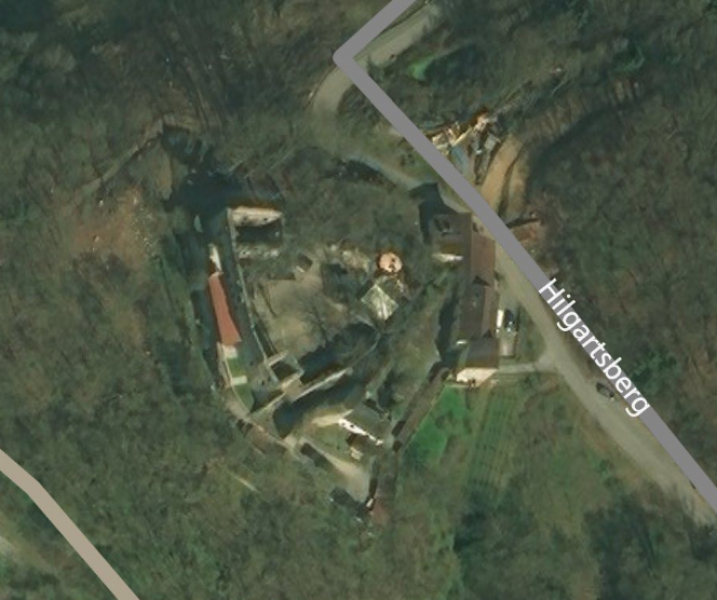
The castle follows a triangular layout. From the northeast, a bridge crosses a ditch and leads through a gatehouse into the outer bailey. Three gateways, sturdy curtain walls and the surviving walls of the great hall hint at just how imposing the fortress once was. Tucked into the outer bailey is the well-preserved Chapel of St George, whose oldest sections date back to the Romanesque period. It was vaulted and decorated with ceiling paintings in the 16th century, and its late Rococo altarpiece depicts the Annunciation. The chapel is still used for weddings and christenings today. In the inner courtyard, an open-air stage has been set up for performances, and a small museum displays archaeological finds from the area – from Stone Age tools and Bronze Age weapons to Celtic brooches and Roman coins.
Events and the Castle Café
Since 1995, a dedicated heritage association has been breathing new life into the ruins with a packed programme of events. Highlights include the Hilgartsberg Castle Festival with open-air theatre in the courtyard, Walpurgis Night with traditional costumed processions, and the atmospheric Castle Christmas Market on the third weekend of Advent, which draws several thousand visitors and ranks among the most popular festive markets in the region. On the castle café's sun terrace, you can enjoy coffee and cake while taking in the panoramic views over the Danube valley.
Historical Information
Hilgartsberg's story reaches back to the early 12th century, when a nobleman named Ezil de Hilkerirchesberg first appears in the historical record in 1112. The hilltop fortress belonged to the County of Windberg and was held as a fief from the Bishops of Bamberg. Over the following centuries, the castle passed through a remarkable number of hands: from the Counts of Sulzbach to the Hohenstaufen dynasty, then to the Counts of Ortenburg, who sold it to the Duchy of Bavaria in 1259. From the late 14th century it was managed by ducal administrators, before eventually passing through several noble families to the wealthy Fugger banking dynasty from Swabia in 1617.
From Castle Fire to Sleeping Beauty
The Fuggers never actually lived in the castle themselves, but after a fire in 1626 they invested heavily in rebuilding it. At its peak, the complex boasted dozens of chambers, kitchens and granaries. The end came in 1742 during the War of the Austrian Succession, when the castle was destroyed for good. The keep was demolished in 1824, and in 1847 the ruins passed to the Bavarian state. It wasn't until 1995 that the municipality of Hofkirchen acquired the site and entrusted its care to a newly founded heritage association. Since then, the Chapel of St George has been fully restored and the ruins have been transformed into a vibrant cultural venue.
How to get there
From direction Deggendorf
A3 Deggendorf-Passau, Coming from Degendorf take the exit Hofkirchen/Winzer, then continue on ST2322/ST2125 to Hofkirchen and from there on ST2125 to Hilgartsberg. At the entrance to the village a sign shows the way up to the ruins.
From direction Passau
Coming from Passau, take the Garham exit, then continue on the ST2119 to the junction with the ST2318, turn right onto the ST 2318 and after a while turn left following the sign for Hilgartsberg.
Thus, one gets over the plateau to Hilgartsberg.
Before descending into the village, one turns left to the ruins.